Joshua Eckhart
The RookJoshua Eckhart is the Checquy’s Chevalier for foreign operations and one of its foremost military minds. His ability to reshape metal gives him an unusual advantage in combat, while his years of field work and command make him a decisive figure in the response to the Grafter threat. The novel presents him through both the impersonal machinery of Checquy operations and Myfanwy’s more personal observations: a scarred, chain-smoking professional, an effective leader, and a husband and father whose family life persists alongside a demanding career.
Identity and Position
Eckhart is introduced in the Court’s gathering as a man who arrives late while directing an operation by phone. The instructions are precise: a woman arriving by plane is to be detained at Customs under a visa pretext, kept from food and from pipes connected to a larger system, and prevented from communicating freely. The scene establishes his work as practical and security-minded, concerned with containment as much as force. Myfanwy infers that this is Eckhart before he is formally introduced.
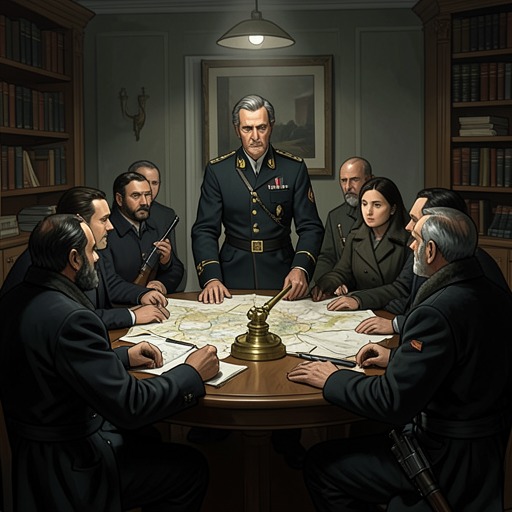
His appearance supports the impression of a working officer rather than a courtly figure. He has thinning blond hair, a hardened expression, a military posture, alert eyes, a tan associated with outdoor work, and numerous scars on his hands. The purple binder identifies him as Major Joshua Eckhart, a Chevalier. In the Checquy’s hierarchy, Chevaliers are responsible for foreign operations and are based at the Annexe; Eckhart’s position places him at the intersection of field command and the Court’s strategic decisions.
Ability and Military Career
Eckhart can manipulate metal by touch. Rather than attracting or repelling it, he makes it fluid and malleable, then reshapes it according to his intention. The ability changes the practical terms of a fight: weapons can alter form to meet circumstances, and conventional bullets are less useful against him. His training turned that power into a distinct fighting method, joining supernatural capacity to military technique rather than treating them as separate skills.
After graduating from the Estate, Eckhart led seven Pawns in international operations. The team was sent to resolve situations beyond the capacity of ordinary units. In Greece, they rescued three British citizens possessed by Spartan ghosts. In Tuscany, they protected a sorcerer who had defected, though the operation included the accidental trampling of the sorcerer’s rare and expensive iguana familiar. The contrast between supernatural danger and the mundane mishap gives these assignments the texture of field work rather than legend.
Eckhart’s career culminated in his appointment to the Court as a Chevalier, the same year Myfanwy graduated from the Estate. By the time of the main action, he has served on the Court for seven years and remains its leading source of military expertise. His army experience and university studies have given him extensive knowledge of military applications, and he has planned operations at many scales. Myfanwy regards him not only as a brilliant fighter but as probably the Court’s most accomplished tactician.
Family and Personal Life
Eckhart was born in York to parents whom Myfanwy’s account describes as exceptionally unpleasant. The Checquy took him away from them as a child; despite this, his parents remained alive and living together in York, supported by a discreet Checquy stipend. Myfanwy contrasts this beginning with Eckhart’s adult closeness to his own family, suggesting that his history did not simply dictate the household he later built.
During training, he went home every weekend. His wife and children were told that he was working on a special government assignment, a cover that was broadly accurate while keeping the nature of the Checquy from them. The purple binder pictures him dividing his days between learning the hidden world alongside other trainees and testing his developing abilities with scientists, teachers, and fighters. His career therefore begins within the Checquy’s practice of separating recruits from ordinary life, but he maintains family attachments rather than living without them.
At a Christmas gathering, Myfanwy meets Eckhart’s wife, Phillipa, and their four children: twin sons in their mid-twenties, a teenage daughter, and a twelve-year-old son. Phillipa describes the cost of his work in the time he spends away from home, and says she expected that life when she married a soldier. Eckhart, meanwhile, arrives with a light touch, joking about the younger children’s effect on Conrad and his wife. The scene presents family life as real and affectionate without pretending that his duties leave it untouched.
Command and the Grafter Conflict
When Myfanwy learns that the Grafters are active in England and that a threat has been traced to London, she is in Reading and asks Eckhart to oversee the strike team. Though newly awakened, he answers in a way that sounds ready for action. Myfanwy then orders the first London Barghest team activated under his command, emphasizing that the operation must remain discreet because the target is in a residential area. The exchange shows the Court using Eckhart as its field commander while Myfanwy, as Rook Thomas, directs the wider response.
Eckhart’s operation takes him to the Grafter home base, where he leads the assault with the Barghests and confronts Graaf Gerd de Leeuwen. The base is a place of active biological production: large sacs and cocoons hang overhead, and pods open to release warriors. The Barghests fight those attackers while Eckhart and de Leeuwen duel, metal meeting bone. Two members of the Barghests are revealed as traitors and turn on their comrades; their Grafter enhancements do not save them. Eckhart uses a chain from the ceiling, reshaping it into a javelin, and kills the skinless Belgian leader with a carefully directed strike.
Narrative Role and Significance
Eckhart’s account of the assault is delivered later in a Court debriefing, after the operation itself. Its clinical quality contrasts with the extraordinary setting and violence it describes: he recounts the fight, the traitors’ betrayal, and the defeat of the Grafter leader without visible emotion. The delayed telling also gives the reader the event as institutional report, after Myfanwy has experienced a night of danger and the Court has begun assembling its understanding of what happened.
Across his appearances, Eckhart connects the Checquy’s hidden bureaucracy to the physical work of protecting it. His phone instructions, operational command, and Court expertise all express the organization’s procedural side; his metal-shaping and direct participation in the base assault embody its capacity for force. Yet his family scenes complicate any picture of the Checquy as a life without attachments. He is at once a soldier whose work takes him away from home and a husband and father whose presence at the Christmas gathering is treated as part of a recognizable domestic world. That combination makes him more than a specialist deployed against the Grafters: he is one of the people through whom the novel shows what the Checquy’s service demands and what its members nevertheless retain.